If you’re caring for someone with arthritis, Parkinson’s, or another condition that affects movement, you’ll already know that the bathroom is often the riskiest room in the house. Wet floors, high bath sides, and awkward taps can turn a simple wash into a real challenge, and a genuine fall risk.
The good news is that “safe” doesn’t mean one single design. What works well for someone with arthritic joints isn’t always what works best for a wheelchair user, and someone with Parkinson’s may need different support again. In this article, we’ll look at the specific features that make the biggest difference for each of these conditions, and explain how they differ from standard bathroom fittings.
Whether you’re researching for yourself or for a parent or relative, understanding these details will help you make a more informed choice, and ask the right questions when it comes to planning a new bathroom.
Why are level-access wet rooms often the safest option for wheelchair users?
For wheelchair users, the single biggest safety feature is the complete removal of steps and thresholds. A wet room has no shower tray to climb over and no lip to catch a wheel or a foot. The floor gently slopes towards a drain, so the whole room can be used as a showering space without any barrier at all.
This matters for practical reasons too. A standard shower tray is usually too high to wheel over safely, and manoeuvring a wheelchair in a cramped bathroom increases the risk of a fall during a transfer. A properly designed wet room gives enough turning space for a wheelchair or a carer to assist safely, which standard bathrooms rarely allow for.
Could a low-threshold walk-in bath ease the strain of arthritis?
Traditional baths ask a lot of stiff or painful joints. Stepping over a high bath side puts strain on hips, knees, and ankles, exactly the joints most affected by arthritis. A walk-in bath removes this problem with a low, easy-to-cross threshold and a door that opens and seals shut, so there’s no lifting of the leg required at all.
Many walk-in baths also include a built-in seat at a comfortable height, meaning the user doesn’t need to lower themselves right down to the floor of the bath and then push back up again, a movement that can be genuinely painful with arthritic knees or hips.
Why do grab rails need to be positioned differently depending on the condition?
Grab rails aren’t a one-size-fits-all fitting. For someone with arthritis, rails are often most useful near seating and at bath or shower entry points, positioned to support pushing up from a seated position without twisting a painful wrist. For someone with Parkinson’s, rails need to be placed along likely walking routes too, not just at fixed points, since balance can be lost at any stage of moving through the room.
For wheelchair users, rails are usually positioned to assist with transfers to and from the chair, rather than for standing support. This is why a proper assessment of how someone actually moves through their bathroom matters far more than simply fitting rails wherever there’s space on the wall.
How can flooring reduce the risk of falls for people with Parkinson's?
Parkinson’s can affect balance, and cause “freezing” episodes where a person’s feet seem to stick to the floor mid-step. Anti-slip flooring with a slightly textured, non-glossy finish gives far more grip underfoot than standard bathroom tiles, particularly when wet. This reduces the chance of a slip, and gives more confidence when starting to walk again after a freezing episode.
Flooring with a subtle colour contrast against walls and fittings can also help. Depth perception and visual processing can be affected by Parkinson’s, so being able to clearly see where the floor meets the edge of a bath or shower area helps someone judge distances more accurately.
Why do lever taps make such a difference for painful or weak hands?
This is a small detail that makes a big difference. Traditional twist taps ask for a pinching, rotating grip, which is genuinely difficult and sometimes painful for someone with arthritis in the hands or fingers. Lever taps only need a light push with a palm, wrist, or even an elbow, and thermostatic mixer valves mean the temperature is pre-set safely, so there’s no fiddly adjusting needed each time.
For someone with tremor caused by Parkinson’s, this also reduces the risk of scalding, since there’s less risk of accidentally knocking a tap to a hot setting while trying to adjust it.
Could a fold-down shower seat help with balance and fatigue?
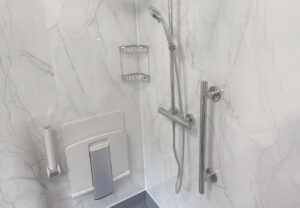
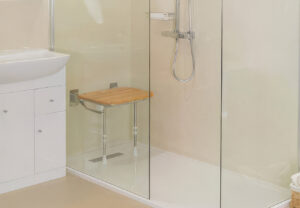
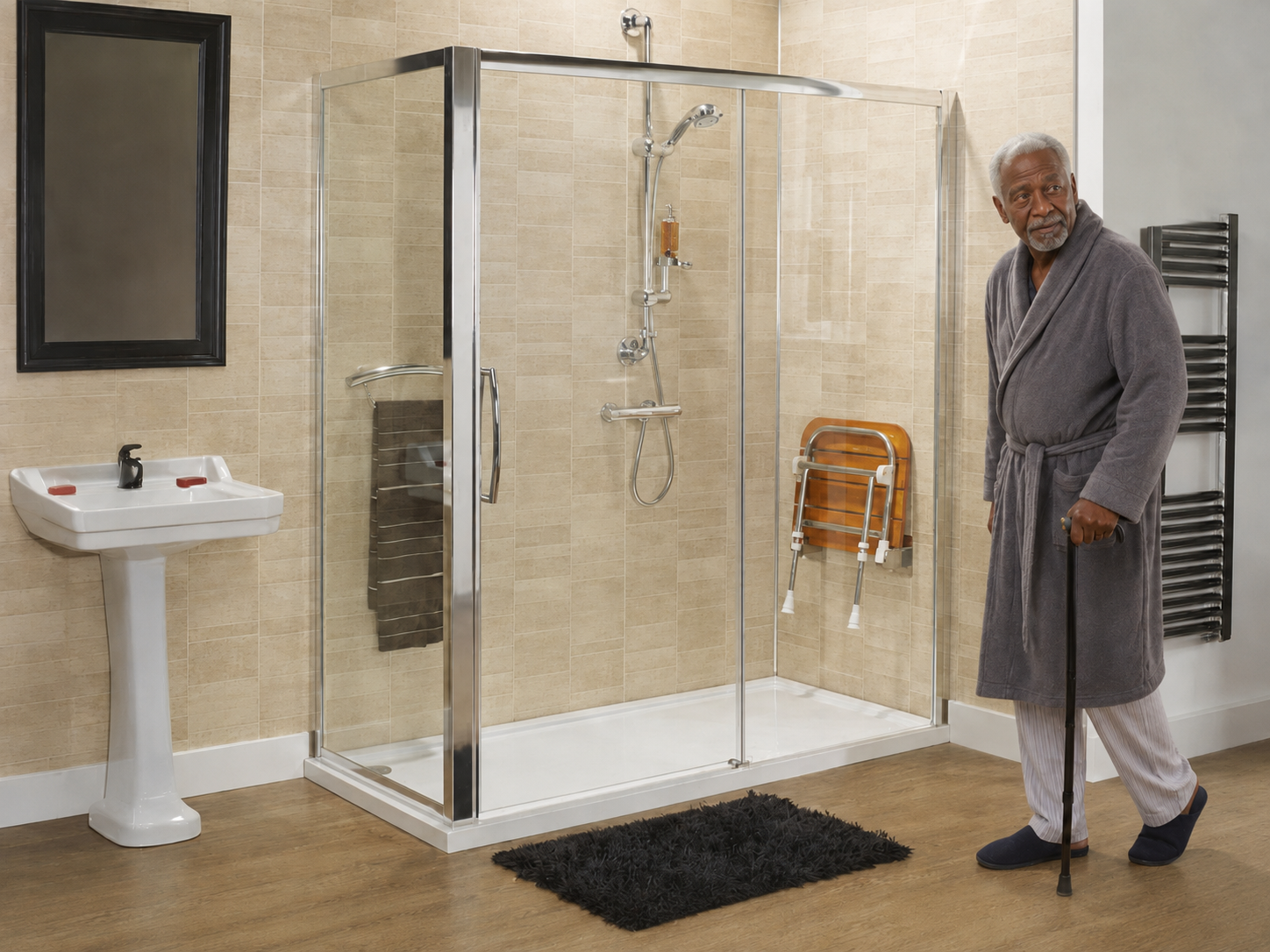
Standing in a shower for any length of time is tiring, and for many people with joint pain or balance issues, it’s simply not possible without a real risk of falling. A fold-down or fixed shower seat gives a stable, supported place to sit while washing, and takes the pressure off knees, hips, and lower backs.
Fold-down seats are particularly useful in shared households, since they tuck away against the wall when not needed. For wheelchair users, a fixed seat at the correct transfer height is usually more appropriate, allowing a safe, controlled move from chair to seat.
Why does door design matter more than people expect?
An easy-open door might seem like a small feature, but it has real safety value. Outward-opening or sliding doors mean that if someone were to fall near the entrance, they wouldn’t be trapped inside by a door that only opens inwards. Easy-grip handles, rather than small knobs, also help anyone with reduced hand strength or grip.
Could colour contrast make a bathroom easier and safer to use?
This is a feature that often gets overlooked. Using a clear colour contrast between the floor, walls, and key fittings such as grab rails or a toilet seat helps enormously with depth perception, particularly for older adults and those with Parkinson’s. Being able to clearly see the edge of a step-free shower area, or spot a grab rail instantly, reduces hesitation and the risk of misjudging a movement.
Why trying a bathroom before you commit makes such a difference
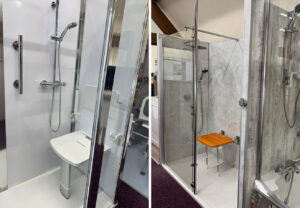
Reading about features is useful, but there’s no substitute for actually sitting in a walk-in bath, testing a shower seat, or wheeling into a wet room to see how it feels. At our showroom in Seckington, Tamworth, the largest mobility bathroom showroom in the UK, you can do exactly that. We’ll happily talk through which features suit your specific needs, whether that’s arthritis, Parkinson’s, or a wheelchair, with no pressure to decide on the day. Home visits are also available if getting to us isn’t practical.
Frequently asked questions
Is a walk-in bath or a walk-in shower better for arthritis?
It depends on personal preference and the severity of joint pain. Walk-in baths suit those who find warm water soothing for stiff joints and want to soak, while walk-in showers with a seat are often quicker and easier for those who struggle with longer periods of standing or transferring.
Do wet rooms need planning permission?
Generally, no. Most domestic wet room installations count as internal alterations and don’t require planning permission, though it’s always worth checking with your local authority if your property has any specific restrictions, such as being listed.
Can a mobility bathroom be fitted in a small space?
Yes. Wet rooms, walk-in showers, and compact walk-in baths can all be designed to fit smaller bathrooms. A proper assessment of the space will identify which layout makes the best use of the room available.
How long does it take to have a mobility bathroom installed?
Are these bathroom adaptations only suitable for older people?
Will an accessible bathroom look clinical or unattractive?
No. Modern accessible bathrooms are designed to look just as stylish as any standard bathroom, with a wide choice of tiles, colours, and finishes. Safety features can be built in without the room looking or feeling like a hospital bathroom.