Showering is one of those daily routines most of us do without a second thought, until getting in and out of the bath or shower starts to feel like a risk rather than a routine. For elderly people, or anyone living with reduced mobility, a slippery shower tray or a high step over the side of a bath can turn a simple wash into a genuine safety concern. It’s little wonder that “what is the safest way for an elderly person to shower” is one of the questions we hear most often at our showroom.
The good news is that there are proven, practical solutions. A well-designed walk-in shower or a level access wet room can remove almost every hazard from the equation, while still giving you a proper, comfortable wash rather than a rushed strip wash. In this article, we’ll look at what makes these two options so much safer, how they differ from one another, and what’s worth thinking about when choosing between them.
Whether you’re considering changes for yourself, or you’re helping a parent or relative stay safe and independent at home, we hope this gives you a clear and honest picture of your options.
Why does showering become riskier as we get older?
As we age, changes in muscle strength, balance, and eyesight naturally make everyday movements a little harder. Bending, stepping, and reaching, all things we do without thinking in the shower, become more difficult, and the consequences of getting them wrong are more serious. NHS and Age UK guidance both point to the bathroom as one of the most common places in the home for falls, largely because of wet, slippery surfaces and steps in and out of the bath or shower. Roughly a third of people over 65 have at least one fall a year, and that figure rises to around half of people over 80.
None of this means a shower has to be dangerous. It simply means the design of the shower matters more as we get older. Traditional showers over a bath, with a high step and a slippery enamel surface, were never designed with mobility in mind. Walk-in showers and wet rooms are.
What makes a walk-in shower safer than a standard shower?
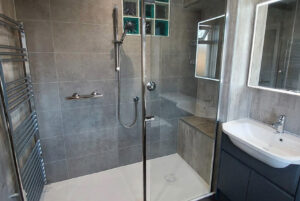
A walk-in shower is built around a low or level threshold, so there’s no high step to climb over. The shower tray itself has a textured, slip-resistant surface, and an easy-open door replaces any awkward shower screen. Many of our walk-in showers also include a fold-down seat, so you can sit comfortably rather than standing for the whole time, and sturdy grab rails positioned exactly where they’re needed.
Taken together, these features remove most of the risk points in a typical shower. You’re not stepping up or down, you’re not gripping a slippery surface with nothing to hold onto, and you’re not forced to stand if standing for long periods is uncomfortable or tiring. For many of our customers, a walk-in shower is the simplest and most cost-effective way to make daily washing safer, without needing a full room renovation.
What is a wet room, and when is it the better choice?
A wet room takes the same principle a step further. Rather than having a separate shower tray, the whole floor is waterproofed and gently sloped towards a drain, so there’s no lip, step, or tray edge anywhere in the room. This makes a wet room particularly suitable for wheelchair users, or for anyone who needs a carer or family member to help with bathing, since there’s simply more room to move around safely.
Because a wet room has no raised threshold at all, it’s often the preferred option for people with more significant mobility needs, or for households planning ahead for future changes in mobility. The trade-off is that a wet room usually involves more building work than a walk-in shower, since the whole floor needs to be tanked and sloped correctly. It’s a bigger job, but for many families it’s worth it for the extra flexibility and peace of mind.
Walk-in shower or wet room: which one suits your bathroom?
The right choice depends on the mobility needs of the person using it, the size and layout of the existing bathroom, and whether a carer needs to be present during washing. As a general guide:
- A walk-in shower usually suits someone who can stand or transfer with some support, and who wants a straightforward, less disruptive installation.
- A wet room usually suits a wheelchair user, someone with more significant mobility needs, or a household where a carer needs space to assist safely.
- A wet room is often the better long-term choice if you’re planning ahead for mobility needs that may increase over time.
- A walk-in shower can often be fitted into a smaller bathroom, where a full wet room conversion may not be practical.
Because every home and every person’s needs are different, we always recommend a proper assessment before deciding. That’s exactly why we offer free consultations, either at our showroom near Tamworth, the largest mobility bathroom showroom in the UK, or with a home visit where one of our advisors can look at your bathroom and talk through what would work best.
How do you know when it's time to make a change?
It’s rarely one single moment that makes a bathroom change necessary. More often, it’s a gradual build-up of small warning signs: gripping the edge of the bath a little tighter than you used to, feeling less steady on wet tiles, or a family member starting to worry about you showering alone. If any of that sounds familiar, it’s worth having the conversation sooner rather than later, rather than waiting until after a fall or a scare.
With over 25 years of experience designing and installing accessible bathrooms, and accreditation from Checkatrade, The Guild of Master Craftsmen, Trustatrader, and Which? Trusted Trader, our team has helped thousands of people across the UK make this change with as little disruption as possible.
Frequently asked questions
Is a walk-in shower or a wet room better for an elderly person?
It depends on the individual’s mobility. A walk-in shower with a fold-down seat and grab rails works well for someone who can stand or transfer with a little support. A wet room, with its completely level floor, tends to suit people with more significant mobility needs, or households where a carer needs to help with washing.
How long does it take to install a walk-in shower or wet room?
A walk-in shower can often be installed in a few days, since it usually reuses much of the existing bathroom layout. A wet room typically takes a little longer, as the whole floor needs to be waterproofed and sloped correctly. Our team will always give you a clear timescale before work begins.
Can a wet room be fitted into a small bathroom?
Yes, a wet room can work well in a smaller space, since there’s no bulky shower tray or screen to fit around. That said, a walk-in shower can sometimes be a simpler and less disruptive option if space is very tight.
Do I need planning permission to install a walk-in shower or wet room?
In most cases, no. Installing a walk-in shower or a wet room is generally considered permitted development, since it doesn’t usually involve structural changes to the property. If you live in a listed building or a flat, it’s worth checking with your local authority first, and our team can advise you during your consultation.
Will a walk-in shower or wet room affect the value of my home?
Accessible bathrooms are increasingly seen as a practical, sensible addition to a property, particularly as more people look to stay in their own homes for longer. A neatly finished walk-in shower or wet room is unlikely to put off future buyers, and in many cases it can be an appealing, low-maintenance feature.
How do I arrange a consultation to discuss my options?
You can book a free consultation at our showroom near Tamworth, where you can see and try our range of walk-in showers and wet room finishes in person, or we can arrange a home visit if that’s easier. Either way, one of our advisors will take the time to understand your needs before recommending anything.