If you’ve started finding your shower more difficult to use than it used to be, you’re certainly not alone. A high step over the bath, a slippery floor, or a fiddly temperature dial can turn a simple daily routine into something stressful, or even dangerous. An accessible shower is designed to remove those obstacles, so you can wash safely and confidently without having to think twice.
But “accessible shower” isn’t a single, fixed product. The right combination of features depends on your mobility, your balance, and whether you need support from a carer or family member. At Life Quality Bathing, we’ve spent over 25 years designing and fitting accessible showers for people across the UK, so we understand which features genuinely make a difference and which are just nice extras.
In this article, we’ll walk through the key features worth considering, from level access and seating through to flooring and controls, so you can make an informed choice for your own home or for a loved one.
Why does level access matter so much?
Level access means there’s no step or lip to climb over when getting into the shower. This might sound like a small detail, but it’s often the single biggest safety improvement you can make. Stepping over a bath edge or shower tray lip requires balance, strength, and a bit of a leap of faith, three things that become harder to rely on as we get older or if you’re living with a condition that affects your mobility.
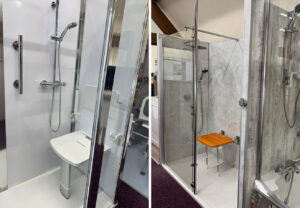
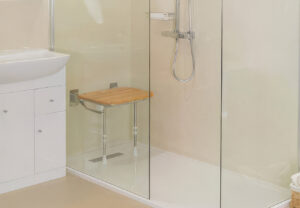
A level access shower allows you to walk, wheel, or be assisted straight in, with no obstacle underfoot. It’s particularly important if you use a wheelchair, walking frame, or shower chair, but it also benefits anyone who simply wants one less thing to worry about each morning. Research on falls among older adults consistently points to bathrooms as one of the most common places for a fall to happen at home, so reducing trip hazards at the point of entry is a sensible place to start.
Could a fold-down seat make bathing safer and more comfortable?
Standing for the whole length of a shower can be tiring, and for some people it simply isn’t possible without support. A fold-down seat gives you somewhere secure to sit while washing, which reduces fatigue and takes the pressure off aching knees, hips, or backs.
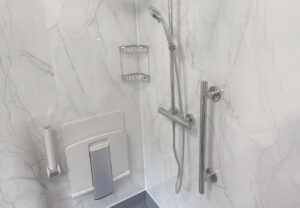
The best fold-down seats are sturdy, wall-mounted, and fold flat against the wall when not needed. We’d always recommend a seat rated for a clear weight limit, fixed into a solid wall rather than a flimsy panel, so it stays secure for years of daily use.
Why are grab rails still one of the most important safety features?
Grab rails are one of the simplest additions to a shower, yet they remain one of the most effective. A well-positioned rail gives you something solid to hold onto when stepping in, standing up, or steadying yourself if you feel a little unsteady on wet tiles.
Positioning matters as much as the rail itself. A rail fitted in the wrong spot, or one that isn’t fixed into a proper wall support, can do more harm than good. When we design a shower, we think carefully about where you’re likely to need support most, such as near the entrance, beside the seat, and close to the controls, rather than simply adding a rail as an afterthought.
How does anti-slip flooring reduce the risk of a fall?
Wet flooring is one of the most common causes of bathroom falls, and standard shower trays or tiles can become genuinely dangerous once soap and water are involved. Anti-slip flooring is textured to provide grip even when wet, without feeling rough underfoot.
Good anti-slip flooring should also be easy to keep clean, as textured surfaces can sometimes trap grime if the wrong material is chosen. We use flooring that balances safety with practicality, so you get the grip you need without extra cleaning work.
What is a thermostatic shower control and why is it worth having?
A thermostatic control keeps the water at a set, safe temperature, even if the pressure changes elsewhere in the house, for example if someone flushes a toilet or runs a tap. This matters for two reasons. First, it prevents sudden scalding or cold shocks, which can be more than unpleasant if your reactions or skin sensitivity have changed with age. Second, it means you don’t need to fiddle with dials mid-shower.
Many thermostatic controls also come with large, clearly marked dials or lever handles, which are much easier to see and grip than small, fiddly knobs, particularly if you have arthritis or reduced hand strength.
Why choose a handheld shower head over a fixed one?
A handheld shower head, usually mounted on a sliding rail, gives you far more flexibility than a fixed overhead unit. You can direct the water exactly where you need it, whether that’s rinsing your feet while seated or washing your hair without having to stand and turn under a fixed jet.
This is especially useful if you’re being assisted by a carer or family member, as it allows them to wash you thoroughly without you needing to move around. A sliding rail also means the shower head height can be adjusted to suit different users in the same household.
What should you look for when putting these features together?
Every home and every person is different, so the right accessible shower usually combines several of these features rather than relying on just one. When we visit a home or welcome someone to our showroom, which is the largest dedicated mobility bathroom showroom in the UK, we typically talk through:
- How much support you need to get in and out safely, and whether a level access design or a low-threshold shower tray suits your bathroom layout.
- Whether a fold-down seat and grab rails should be positioned for use by you alone, or also by a carer helping you.
- What flooring will give you the right grip without becoming difficult to keep clean.
- Whether you’d benefit from a thermostatic control and a handheld shower head on a sliding rail.
We’re accredited by Checkatrade, The Guild of Master Craftsmen, Trustatrader, and Which? Trusted Trader, so you can be confident the advice you receive, and the installation itself, meets recognised standards.
Getting the design right for your home
An accessible shower should fit around your life, not the other way round. That’s why we offer both showroom consultations and home visits, so we can see exactly how your existing bathroom is laid out and recommend features that will genuinely help, rather than a generic package that doesn’t suit your space. Whether you need a full wet room, a walk-in shower, or a smaller-scale adaptation, the goal is always the same: a bathroom that lets you wash safely, comfortably, and with a bit more independence.
Frequently asked questions
Do I need to remove my bath to install an accessible shower?
Not always. In many homes, we can replace a bath with a level access shower in the same footprint, but if you’d prefer to keep some bathing options, an easy access shower bath can offer a middle ground. It’s worth having a chat with us about your bathroom’s layout before deciding either way.
Will an accessible shower fit in a small bathroom?
Yes, in most cases. Accessible showers can be designed to fit smaller spaces, and features like fold-down seats and sliding shower rails are chosen specifically because they don’t take up permanent floor space. We measure your bathroom carefully before recommending a layout.
How long does it take to fit an accessible shower?
Are grab rails and fold-down seats suitable for all ages?
Can a carer or family member help me shower more easily with these features?
Do accessible showers look clinical or hospital-like?
Not with modern design. Accessible showers today come in a wide range of styles, tiles, and finishes, so there’s no need to sacrifice how your bathroom looks in order to make it safer. Many of our customers are pleasantly surprised by how stylish the end result is.