Living with Parkinson’s brings a unique set of daily challenges, and the bathroom is often where those challenges feel most pressing. Tremors, muscle stiffness, slower movements, and difficulties with balance can all make what was once a simple routine feel uncertain and, at times, genuinely risky. It’s not a comfortable thing to think about, but it’s important, because the right bathroom setup can make an enormous difference to both safety and independence.
At Life Quality Bathing, we’ve worked with many customers and families navigating exactly this situation. We’ve designed and installed accessible bathrooms across the UK for people with a wide range of mobility needs over the past 25 years, including those living with Parkinson’s disease. We understand that there’s no single solution that suits everyone, because Parkinson’s affects people differently, and the right bathroom depends on the individual.
This guide is here to help you think through the options clearly, whether you’re considering a change for yourself or researching on behalf of someone you care for.
Why the bathroom is one of the highest-risk rooms for people with Parkinson’s
Falls are a significant concern for anyone with Parkinson’s, and the bathroom is a particularly hazardous space. Wet, hard surfaces, the need to step over a bath edge, reaching for taps, and moving between standing and seated positions all create moments where balance and coordination are tested. According to Parkinson’s UK, around two thirds of people with the condition fall at least once a year, and a large proportion of those falls happen in or around the home.
The problem isn’t just the risk of a fall itself. It’s also the anxiety that builds around daily bathing routines. When getting washed becomes something you dread or need to rush, it affects wellbeing, confidence, and dignity. A well-designed accessible bathroom removes many of those risks and, just as importantly, removes much of that worry.
What features matter most in a Parkinson’s-friendly bathroom?
When designing a bathroom with Parkinson’s in mind, there are several features that consistently make the greatest practical difference:
- Non-slip flooring throughout. Smooth tiles, even when dry, can be slippery for someone with an unsteady gait. Purpose-built wet room flooring and anti-slip shower trays significantly reduce the risk of a fall.
- Grab rails in the right places. Strategically positioned grab rails near the toilet, alongside the bath or shower entry, and by the wash basin give something solid to hold during vulnerable moments.
- A fold-down shower seat. Sitting down to shower removes the need to balance on one foot while washing. It also reduces fatigue, which is a common issue for people with Parkinson’s, particularly later in the day.
- Level or low-threshold access. Stepping over a traditional bath or shower tray edge is one of the most common causes of falls. A level-access wet room or a walk-in shower with a low-profile tray eliminates that step entirely.
- Easy-to-use controls. Lever-style taps and thermostatic shower controls (which prevent sudden changes in water temperature) are far easier to manage when fine motor control is affected by tremor.
Walk-in shower or wet room: which is better for someone with Parkinson’s?
Both walk-in showers and wet rooms offer excellent solutions for people with Parkinson’s, and the right choice depends largely on your bathroom size, your current level of mobility, and whether you may need assisted bathing in the future.
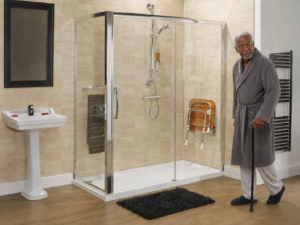
A walk-in shower is typically the most popular choice in the earlier and middle stages of the condition. With a low or zero-threshold tray, a fold-down seat, a handheld shower head, and well-placed grab rails, it provides a safe and comfortable space to bathe independently. Our walk-in showers are designed with precisely these considerations in mind.
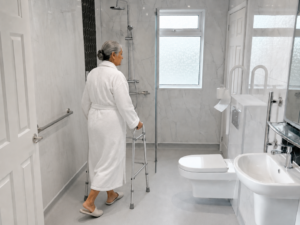
A wet room takes accessibility a step further. Because the entire floor is level and fully waterproofed, there is no tray or step to navigate at all. This makes wet rooms particularly well suited to people who use a wheelchair or who may need a carer to assist them. The open, spacious design means there’s more room to manoeuvre safely. If you’re thinking long-term and want a bathroom that will adapt with you as Parkinson’s progresses, a wet room is worth serious consideration.
Is a walk-in bath a good option for people with Parkinson’s?
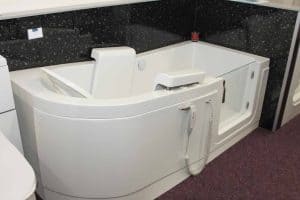
Walk-in baths have become popular with older adults and people with reduced mobility, and for some people with Parkinson’s they can be a good choice, particularly for those who find a warm soak beneficial for easing muscle stiffness.
The key practical point to understand with a walk-in bath is the entry and exit process. You open the side door, step in, sit down, close the door, and then fill the bath. When you’ve finished, you drain the water before opening the door to exit. This means you’re sitting in an empty bath for a short time while you wait for the water to drain, and you also need to be able to stand up from a seated position once the bath is empty.
For some people with Parkinson’s, particularly those who experience significant freezing of movement or who find it difficult to rise from a low seated position, a walk-in bath may not be the most practical choice. This is why we always recommend speaking to one of our team before deciding. We can help you think through what will work best for your specific situation.
How the right bathroom design supports independence and dignity
There’s something that goes beyond the practical when we talk about accessible bathrooms for people with Parkinson’s, and that’s the matter of independence. Being able to wash and care for yourself without relying on someone else is deeply tied to self-esteem and quality of life. When a bathroom becomes unsafe or difficult to manage, people often start to avoid bathing or rely more heavily on carers or family members, sometimes before that’s truly necessary.
A thoughtfully designed accessible bathroom can help preserve that independence for longer. It removes the specific physical barriers that Parkinson’s creates, rather than simply working around them. That’s a meaningful distinction. We’ve had many customers tell us that having the right bathroom in place gave them back a sense of control and confidence that they’d started to feel was slipping away.
What to expect when you contact Life Quality Bathing
We know that making changes to your bathroom can feel like a big decision, especially when you’re already managing a lot. Our process is designed to be as straightforward and low-pressure as possible. We start with a conversation, either at our showroom in Seckington, Tamworth (the largest mobility bathroom showroom in the UK) or via a home visit if that’s easier for you.
During that conversation, we’ll listen to what your current bathroom is like, what difficulties you’re experiencing, and what matters most to you. We’ll then talk through the options that would work best for your home, your mobility, and your budget. There’s no obligation and no pressure. We’re independently accredited by Checkatrade, The Guild of Master Craftsmen, Trustatrader, and Which? Trusted Trader, and our reputation is built on doing things properly.
If you’d like to see examples of the kind of accessible bathrooms we install before getting in touch, you’re welcome to browse our work on our website or visit us in person.
Frequently asked questions
Can a walk-in shower really be used safely if I have significant tremors?
Yes, with the right features in place. A walk-in shower designed for someone with Parkinson’s will typically include a fold-down seat so you don’t need to stand throughout, a handheld shower head for flexibility, grab rails positioned where you need them most, and a non-slip tray or level-access floor. Thermostatic controls mean you don’t need to adjust hot and cold separately, which is helpful when fine motor control is affected. The aim is to design out the moments where tremors or balance issues create risk.
My parent has Parkinson’s and is starting to need help bathing. Is a wet room suitable for assisted bathing?
Wet rooms are one of the best options for assisted bathing. The fully level floor means a carer can move around easily and safely, and there’s no step or tray to navigate. There’s also more space for a shower chair or commode-style shower seat if needed. If assisted bathing is likely to become a regular requirement, a wet room is often the most practical and future-proof choice.
How long does it take to have an accessible bathroom installed?
Is there a difference between a mobility bathroom and a standard accessible bathroom?
What if my Parkinson’s progresses and my needs change in the future?
This is something we think about carefully when designing accessible bathrooms for people with progressive conditions. We’ll talk with you about where you are now and where you might reasonably be in five or ten years, so the bathroom we design works well today and continues to work well as things change. A wet room, for example, is inherently more adaptable than a shower enclosure because it can accommodate a wheelchair, a shower trolley, or a carer with ease. We’d rather design something that grows with you than something that needs replacing too soon.
Do you offer home visits, or do I need to come to your showroom?
We offer both. If you’re able to visit us, our showroom in Seckington, Tamworth is the largest mobility bathroom showroom in the UK and gives you the chance to see and touch the products in person. However, we fully understand that travelling isn’t always easy, particularly if mobility is already a challenge. We’re happy to arrange a home visit instead, where one of our team can see your existing bathroom and discuss your options in your own space.