A slip in the bathroom can happen in a split second, and the consequences for an older person can be serious. Broken bones, loss of confidence, and a sudden reluctance to bathe independently are all common outcomes of bathroom falls. Yet despite how frequently these accidents occur, many people assume that a few rubber bath mats are enough to manage the risk. In most cases, they are not.
The good news is that the majority of bathroom slips and falls are preventable. With the right combination of practical adaptations, thoughtful design, and purpose-built equipment, it is entirely possible to make bathing and showering much safer without sacrificing comfort or dignity. This article explores the most effective steps you can take, from simple additions you can make today to longer-term bathroom changes that could make a real difference to day-to-day life.
At Life Quality Bathing, we have spent over 25 years helping people across the UK make their bathrooms safer. Whether you are thinking about your own needs or those of a parent or relative, we hope this guide gives you a clear picture of what is available and what is most likely to help.
Why are bathrooms such a common place for falls?
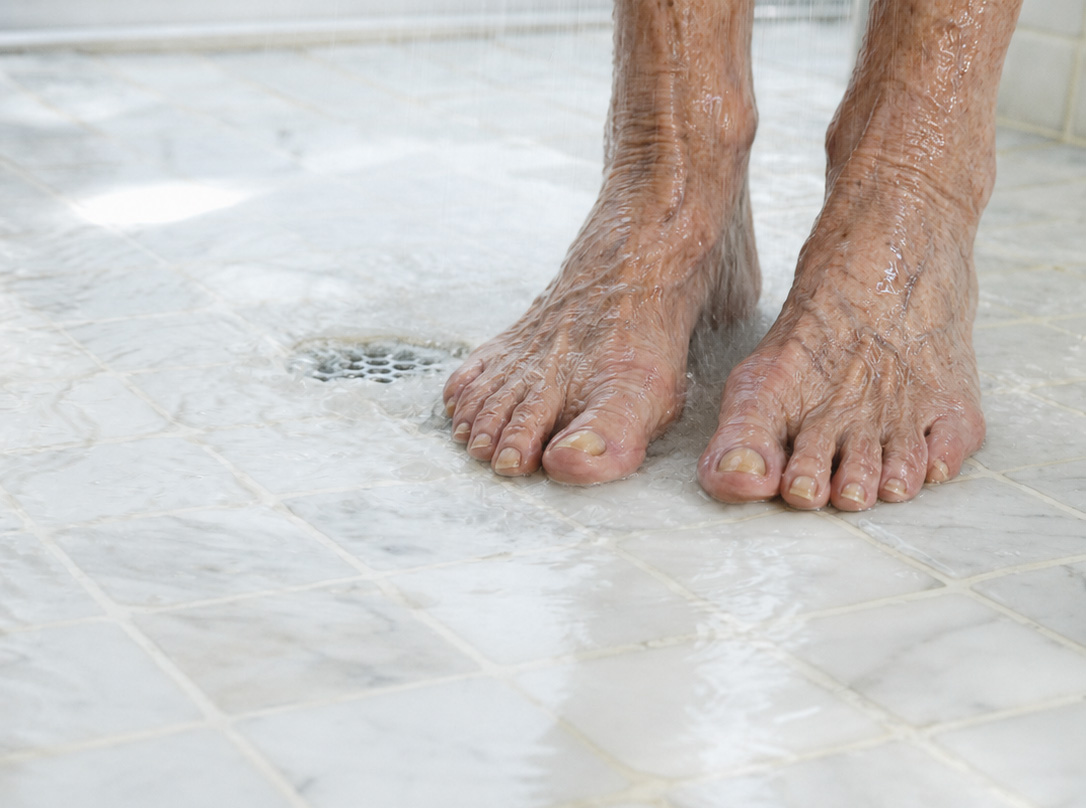
The bathroom combines several conditions that increase the risk of a fall. Wet, soapy surfaces are inherently slippery. Getting in and out of a bath requires you to lift your leg over a raised edge while balancing your weight on one foot. Bending, reaching, and twisting are all common movements during bathing, and these can be challenging for anyone with reduced flexibility or balance.
For older adults, these challenges are often compounded by age-related changes such as weaker muscles, reduced joint mobility, slower reaction times, and conditions like arthritis or dizziness. According to the NHS, falls are the most common cause of injury-related deaths in people over 75 in the UK, and the bathroom is one of the most frequent locations where they happen.
Understanding why the bathroom is risky helps us to think clearly about where the solutions should be focused. It is rarely about one single weakness. Most falls result from a combination of factors, which means the best approach is to address several areas at once.
What non-slip products make the biggest difference?
Non-slip matting is often the first thing people try, and while it does help, it is important to choose the right kind. A thin rubber mat that curls at the edges or slides easily on a wet floor can create as many problems as it solves. Look for mats with strong suction cups that grip the floor firmly, and make sure they are the right size for the area you are covering.
Anti-slip strips and decals can also be applied directly to the base of a bath or shower tray, and these tend to be more reliable than loose mats because they cannot move underfoot. For the floor outside the bath or shower, a large, heavy-backed bath mat that stays put when wet is far preferable to a small decorative rug.
If you are considering a longer-term solution, purpose-built wet room flooring and textured anti-slip shower trays offer a much higher level of protection. These are designed specifically for this environment and form part of a complete accessible bathroom design rather than a temporary fix added afterwards.
How do grab rails help, and where should they be fitted?
Grab rails are one of the most effective and affordable ways to reduce the risk of a fall in the bathroom. They give you something solid to hold when moving from standing to sitting, when stepping in or out of a bath, or when lowering yourself onto a shower seat. A well-placed grab rail can make the difference between a confident, safe movement and an uncertain one.
The key word here is “well-placed”. A grab rail only helps if it is in exactly the right position for the person using it. As a general guide, a horizontal rail beside the bath is useful for lowering and raising the body, while an angled or vertical rail near the entrance to a shower provides support when stepping over a threshold or changing direction. It is worth taking professional advice on placement rather than simply fitting a rail wherever it is convenient.
It is also essential that rails are fixed securely to the wall. A rail that pulls away from the wall under pressure is more dangerous than no rail at all. If you are unsure whether your walls can support a properly anchored rail, a specialist installer will be able to assess this and use appropriate fixings.
Could a walk-in shower or bath remove the biggest hazard altogether?
For many people, the most significant risk in the bathroom is the traditional bath. Getting in and out requires stepping over a high side while wet and soapy, often without anything solid to hold on to. This is the movement that causes a large proportion of bathroom falls, and no amount of matting or rail placement can entirely eliminate the awkwardness involved.
A walk-in bath is designed to remove this problem at source. Rather than climbing over the side, you open a watertight door in the bath wall, step in on a level or very low threshold, sit down, close the door, and then fill the bath. This entirely avoids the need to balance on one leg over a raised edge. Many of our walk-in baths also include optional features such as hydrotherapy jets, heated seats, and handheld showers, making them a genuinely comfortable choice rather than just a practical compromise.
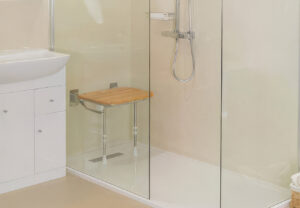
Walk-in showers offer a similar benefit. A low-profile or level-access shower tray removes the step that is so often a trip hazard, and a fold-down shower seat means you can bathe seated if needed. Paired with a thermostatic shower that prevents scalding and a fixed grab rail, a walk-in shower can be one of the safest bathing environments available.
What is a wet room, and is it the right option for you?
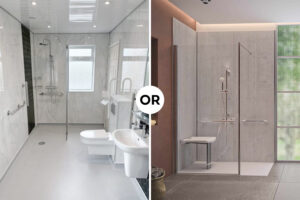
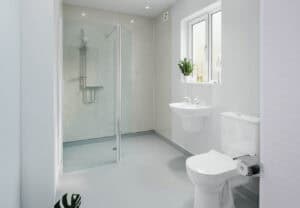
A wet room takes the concept of accessible showering a step further. The entire floor of the room is waterproofed and slopes gently towards a drain, which means there is no tray, no threshold, and no barrier of any kind to step over. For people who use a wheelchair or require assisted bathing, a wet room can be the ideal solution because it allows a carer to assist without squeezing around fixtures or worrying about a raised edge.
Wet rooms look contemporary and work well in a range of bathroom sizes, including smaller spaces where a conventional shower enclosure might feel cramped. The anti-slip flooring used in a properly installed wet room provides excellent grip underfoot, and because the floor is sealed throughout, there are no edges or joins where water can collect and create unexpected slip hazards.
Whether a wet room is the right choice will depend on your bathroom layout, your current and future mobility needs, and your personal preference. Our team can talk you through the options during a consultation at our showroom or during a home visit, whichever is more convenient for you.
Which smaller changes are worth making straight away?
Not every improvement requires a full bathroom renovation. There are several straightforward changes that can make the bathroom safer without major upheaval:
- Replace any loose or lightweight bath mats with large, heavy-backed mats that grip firmly to the floor and do not curl at the edges.
- Fit a bath board or bath seat across the top of the bath, which allows you to sit on the edge, swing your legs in, and lower yourself down rather than stepping in while standing.
- Install a thermostatic mixer tap or shower valve to prevent scalding, which can cause a person to recoil suddenly and lose their balance.
- Improve bathroom lighting, particularly around the bath and shower area. Poor visibility, especially at night, is a contributing factor in many bathroom falls.
- Add a handheld shower head if there is not already one fitted. Being able to direct water without stretching or twisting reduces the need for the unsteady movements that can lead to a slip.
These smaller steps can be put in place quickly and at modest cost, and while they do not replace a purpose-designed accessible bathroom, they can meaningfully improve safety in the short term.
How can a specialist bathroom installer help?
A general builder or bathroom fitter will be able to install a shower or bath, but they will not necessarily have the expertise to design a bathroom specifically around mobility and safety needs. A specialist installer, like our team at Life Quality Bathing, brings a different level of knowledge to the project. We consider the specific challenges the person using the bathroom faces, how those challenges might change over time, and how to design a space that offers real, lasting support rather than just ticking a box.
We are independently accredited by Checkatrade, The Guild of Master Craftsmen, Trustatrader, and Which? Trusted Trader, so you can feel confident that the work will be carried out to a high standard. Our showroom near Tamworth is the largest mobility bathroom showroom in the UK, where you can see and try different options before making any decisions. We also offer home visits if travelling to us is difficult.
If you would like to find out more about how we can help make your bathroom safer, you are very welcome to visit us, give us a call, or explore our range of accessible bathing solutions on our website.
Frequently asked questions
Are rubber bath mats enough to prevent slipping in the bath?
At what age should you start thinking about bathroom safety adaptations?
What is the difference between a walk-in shower and a wet room?
A walk-in shower typically has a low-profile tray and an open or partly open entrance, meaning there is a very small threshold to step over (or none at all). A wet room goes a step further by removing all barriers completely: the floor is fully waterproofed and drains at a central point, making it completely level throughout. Wet rooms are particularly suitable for wheelchair users or anyone who needs assistance when bathing.
How much disruption does installing a walk-in bath or shower cause?
Do walk-in baths hold water properly even with a door in the side?
Yes. Walk-in baths use a secure, watertight door seal that holds water safely once closed. The process is simply to step in before filling the bath, and then drain the bath before opening the door to get out. This is something people often wonder about initially, but it quickly becomes second nature and the seal is designed to remain reliable for many years with normal use.
Can bathroom safety adaptations be fitted in a small bathroom?
Absolutely. Many of the most effective adaptations, including grab rails, fold-down shower seats, and anti-slip flooring, can be installed in bathrooms of any size. Walk-in showers and wet rooms can also be designed to suit smaller spaces and can often make a compact bathroom feel more open and practical than the original layout. Our team will always assess your existing space carefully before making any recommendations.