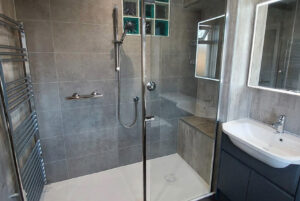
Watching a parent struggle to get in or out of the bath is one of those moments that quietly changes how you see things. It is not usually a single dramatic incident, more a gradual realisation that something you never thought twice about has become a daily worry. If you are reading this because your mum is finding it harder to climb over the bath side, grip the taps for balance, or lower herself down safely, you are not alone, and there are practical, dignified solutions available.
This is not just about safety, although that matters enormously. It is also about your mum’s independence and confidence. Many older people quietly stop bathing as often as they would like, or start relying on family members to help, simply because the bathroom itself has become the obstacle. The good news is that there are several accessible bathing options designed specifically for people in her situation, and most can be fitted without major building work or long disruption to the home.
In this article, we look at why getting in and out of the bath becomes harder with age, the main alternatives (from walk-in baths to level-access wet rooms), and how to work out which suits your mum best.
Why does getting in and out of the bath become harder with age?
A standard bath is designed with little thought for stiff joints, weaker legs, or poor balance. The side is usually around knee height, so stepping over it calls for hip flexibility and leg strength that naturally decline with age. Add a slippery, wet surface underfoot, and it is easy to see why the bathroom is often flagged by the NHS as one of the more common places for falls to happen at home.
For someone with arthritis, a hip or knee replacement, or reduced grip strength, that high step becomes something to dread rather than an inconvenience. If your mum has begun holding onto the sink, the towel rail, or you, just to get in and out, that is a clear sign it is worth looking at alternatives now, rather than waiting for a fall to force the issue.
What is a walk-in bath and could it help your mum?
A walk-in bath is exactly what it sounds like. Instead of climbing over a high side, there is a low-access threshold and a door built into the side that opens and seals shut once your mum is inside. She can step in, sit on a built-in seat, close the door, and fill the bath around her. Many models also include spa or hydrotherapy features, such as gentle water jets, soothing for aching joints and poor circulation.
This option suits people who still enjoy a proper soak but can no longer manage the physical demands of a traditional bathtub. It keeps bathing familiar while removing the risky part of it. Our website has the full range of walk-in bath options we install, if you would like to explore the styles and features further.
Would a walk-in shower or wet room suit her better?
Not everyone wants to keep bathing in the traditional sense, and for some people showering is simply easier and quicker. A walk-in shower typically includes a low-level or level-access tray, a fold-down seat, and grab rails, so your mum can shower sitting down without needing to step over anything or stand for long periods.
A wet room takes this further. The whole floor is level and waterproofed, with a gentle fall towards a drain, so there is no tray or lip at all. This suits your mum well if she uses a wheelchair or walking frame, or needs help washing, since there is space to manoeuvre and nothing to trip over. Wet rooms work best with a reasonable amount of floor space, though good design can make a modest bathroom work well too.
Is an easy access shower bath a good middle ground?
If your mum is not ready to give up bathing entirely but also wants an easier shower option, an easy access shower bath is a sensible compromise. It combines a lower entry point than a standard bath with a shower area built in, so the same bathroom works for both a soak and a quick shower. It suits households where more than one person uses the bathroom, or where flexibility matters most.
What should you think about before choosing an option?
Every family’s situation is different, and the right choice depends on more than the bathroom itself. Before booking a consultation, it is worth thinking through a few practical points with your mum.
- Consider her mobility now, and how it might change in future, so the solution still works further down the line.
- Think about whether she genuinely prefers bathing to showering, rather than assuming one suits her better.
- Measure the bathroom’s current size and layout, since this affects which solution is most practical.
- Discuss budget as a family, including whether grab rails or non-slip flooring should be added at the same time.
- Ask whether she would prefer the existing style kept broadly similar, or whether she is open to a full refit.
How does the installation process actually work?
Making a decision about a new bathroom can feel daunting, particularly if your mum is anxious about disruption or cost. In practice, most installations follow a straightforward path. We offer consultations either at our showroom in Seckington, Tamworth, the largest mobility bathroom showroom in the UK, or through a home visit if travelling is difficult, so your mum can see and try different baths, showers, and finishes for herself.
From there, our team measures up, designs a layout suited to her needs, and agrees a fitting schedule with the family. With over 25 years of experience installing accessible bathrooms, and accreditation from Checkatrade, The Guild of Master Craftsmen, Trustatrader, and Which? Trusted Trader, we aim to make the process as smooth and reassuring as possible.
Could an adapted bathroom help her stay independent for longer?
It is easy to focus purely on the practical side of an accessible bathroom, but the emotional benefit matters just as much. Falls, and the fear of falling, are among the most common reasons older people lose confidence in their own homes, according to the NHS. A bathroom that feels safe rather than risky can make a real difference to how independent your mum feels day to day, and can ease the pressure on family members who currently feel they need to help with every bath or shower.
Many families tell us the change is not just physical. Their parent bathes or showers more regularly again, feels more relaxed doing it alone, and worries less about becoming a burden. For adult children juggling their own households and caring responsibilities, that peace of mind is often just as valuable as the safety improvements themselves.